Workflow · Quantities and carbon
Carbon per m²
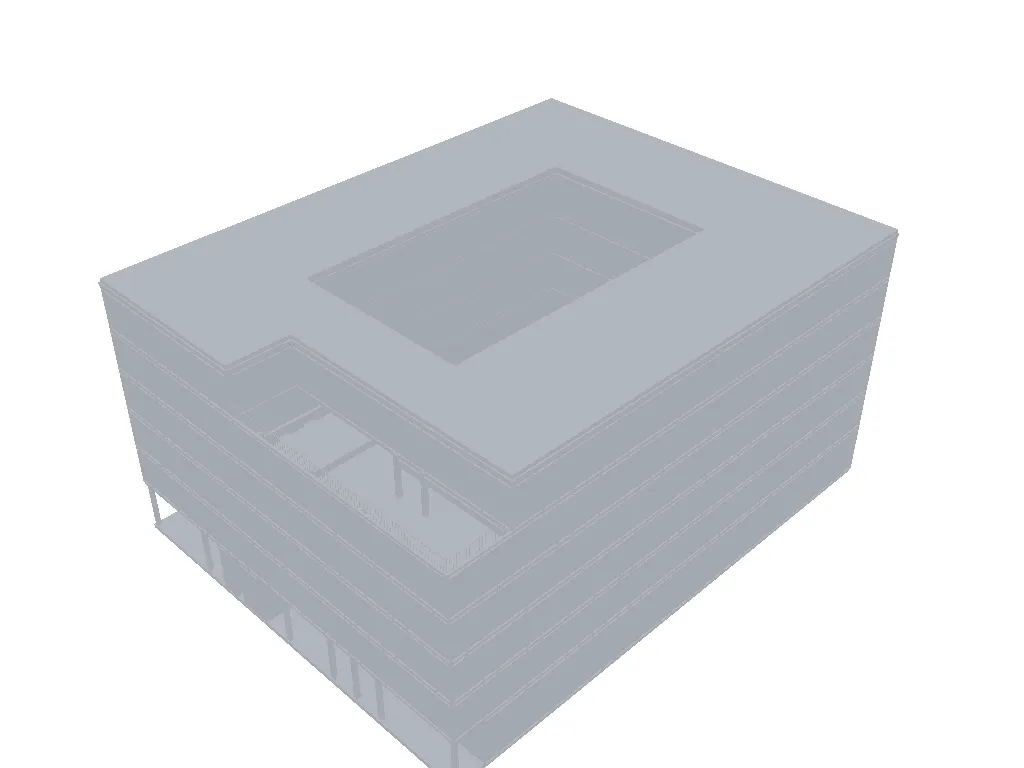
Estimate the embodied carbon of an IFC model per square metre of floor, from its volumes, with ÖKOBAUDAT EPDs where a material matches and generic factors elsewhere. On the Zurich office, an Archi sample model: 288 kg CO2e/m² for A1-A3, an early-stage screening, not a certified LCA.
288 kg CO2e/m² A1-A3 over 9,061.6 m² gross floor area, about 2,610 t CO2e in total · Zurich office
368 kg CO2e/m² whole life over 50 years, 3,336.1 t CO2e
79 % of the volume on ÖKOBAUDAT EPDs
20.7 s to compute
What was checked
EN 15978 modules A1-A3 as the headline, and whole life over a 50-year study period (A4, A5, B4, C1-C4 and D; operational energy B6/B7 out of scope). Area: 9,061.6 m² gross floor area, the sum of the six floor slabs' areas. Volumes from the IFC geometry, net of 153 openings, 9,735 of 9,899 elements with geometry, terrain left out. EPDs: ÖKOBAUDAT EN 15804+A2 for aluminium, concrete and screed, 4,676.8 of 5,924.0 m³ (79 %); glass and glulam on ICE v2 generic factors; 898.4 m³ with no usable material on a 400 kg CO2e/m³ default.
2,610 t CO2e, A1-A3 · early-stage EN 15978 screening estimate; Ökobaudat EPDs for aluminium, concrete and screed (79 % of the volume), generic factors elsewhere; not a certified LCA
Steps, as the assistant ran them
- ifc_job_submit
Ran carbon_estimate with ÖKOBAUDAT EPDs, a gross floor area of 9,061.6 m² and a 50-year whole-life period on the Zurich office IFC; 2,609.9 t CO2e for A1-A3 in 20.7 s.
Tool chain
ifc_job_submit
Programs in this workflow
- IFC · The open IFC model the tools read, check and write
- Quantities and carbon · Computes quantities and embodied carbon from the IFC
Method
The estimate takes each element’s volume from the IFC geometry, with the openings cut, and multiplies it by a factor for its material. Three of the six material classes matched an ÖKOBAUDAT EPD: aluminium (“Aluminiumprofil pressblank”), concrete (“Beton der Druckfestigkeitsklasse C25/30”) and screed (“Zementestrich”), 79 % of the building’s volume. Glass and glulam use ICE v2 generic factors.
A1-A3: 2,609.9 t CO2e, 288 kg CO2e/m². Whole life over 50 years: 3,336.1 t CO2e, 368 kg CO2e/m² (A1-A3 2,609.9 t, A4 14.5 t, A5 3.2 t, B4 763.3 t, C1-C4 112.3 t, and module D −167.0 t counted in that total). The largest shares: aluminium 788 t, mostly the curtain-wall mullions and spandrel panels; concrete 663 t; screed 383 t; glass 380 t.
Limits
- Early-stage EN 15978 screening estimate; Ökobaudat EPDs for aluminium, concrete and screed (79 % of the volume), generic factors elsewhere; not a certified LCA.
- The mullions are modelled as solid 60 × 200 mm bars, so aluminium is overstated. The aluminium EPD is the tool’s first match and is low for anodised curtain-wall profiles; a person should choose that dataset before the figure is used.
- Biogenic carbon stored in timber is left out. The 143 glulam beams carry no material in the IFC and use the generic default (see Option carbon delta).
- The recorded run used an Archi Automate development build; the tools it calls are in the released version.
- The Zurich office is an Archi sample model, not a built project.