Early-stage study, not a daylight or rights-of-light assessment.
Sun hours: dark purple = 0 h, red = about half the day, yellow = the whole day; each frame's legend gives its range (21 June 0–15.8 h, 21 March 0–12.1 h, 21 December 0–8.3 h). Sun and shadow: yellow = in sun, blue = in shadow. Grey = surrounding buildings, shadow casters only. Local clock time (CET/CEST).
Three dates, three views
Zurich office · Sun and shadow study
Viewer recordingswissBUILDINGS3D → sun hours, 3 dates
On 21 June the south-east facade of the Zurich office gets 6.7 hours of direct sun on average and the north-west 2.8; on 21 December the north-west faces get none, and the sun reaches mostly the upper storeys. The court is a summer space: 146 of its 520 ground cells see some sun on 21 June, 8 on 21 December.
That shows early which rooms and outdoor spaces belong on which side, where shading is worth planning, and what to show the neighbours in a first conversation. It is an early-stage study, not a daylight or rights-of-light assessment.
Ask your AI assistant
Run a sun study of the Zurich office for 21 March, 21 June and 21 December and record each day.
Show the full prompt
Using the Archi Automate MCP, take the IFC model of [the office] with its surrounding buildings and run sim_sun for [21 March, 21 June and 21 December 2026], from sunrise to sunset every [30 minutes] in local clock time, with the time series on. Use a [2 m] ground grid over [92 × 92 m] around the building and a [3 × 3 m] grid on the exterior facades only. Show each date in the Archi Automate viewer from [the south-west], with [21 June] also from [the north-east] and [down into the court], capture the cumulative sun hours and one moment of sun and shadow per date, compare the three dates in one top view on one colour range, and record each day with viewer_record, with the viewer's legend, clock and credits on.
- Engine
- Claude (assistant). No image or video model; the colours are computed sun hours.
- Input
- IFC
- Time
- sim_sun 4.3 s (21 March), 1.7 s (21 June), 1.2 s (21 December); viewer_record 10 s per film
- Date
- 2026-11-15
- Tools
- IFC → sim_sun → viewer_record
- MCP calls
- ifc_run_write_task → ifc_save → ifc_job_submit → sim_sun → viewer_show → viewer_set → viewer_capture → viewer_record
Method
Archi Automate output, unretouched. sim_sun computed the direct sun every 30 minutes on 21 March, 21 June and 21 December 2026, in local clock time, on a 2 m grid over 92 × 92 m of ground around the building and on 1,306 cells of about 3 × 3 m on the exterior facades. Each date took 1 to 5 seconds. The films come straight out of the Archi Automate viewer: viewer_record drew each frame from the study’s time series, ten seconds per day. The stills are viewer captures. The viewer draws its own legend, clock, north arrow and credits on every frame.
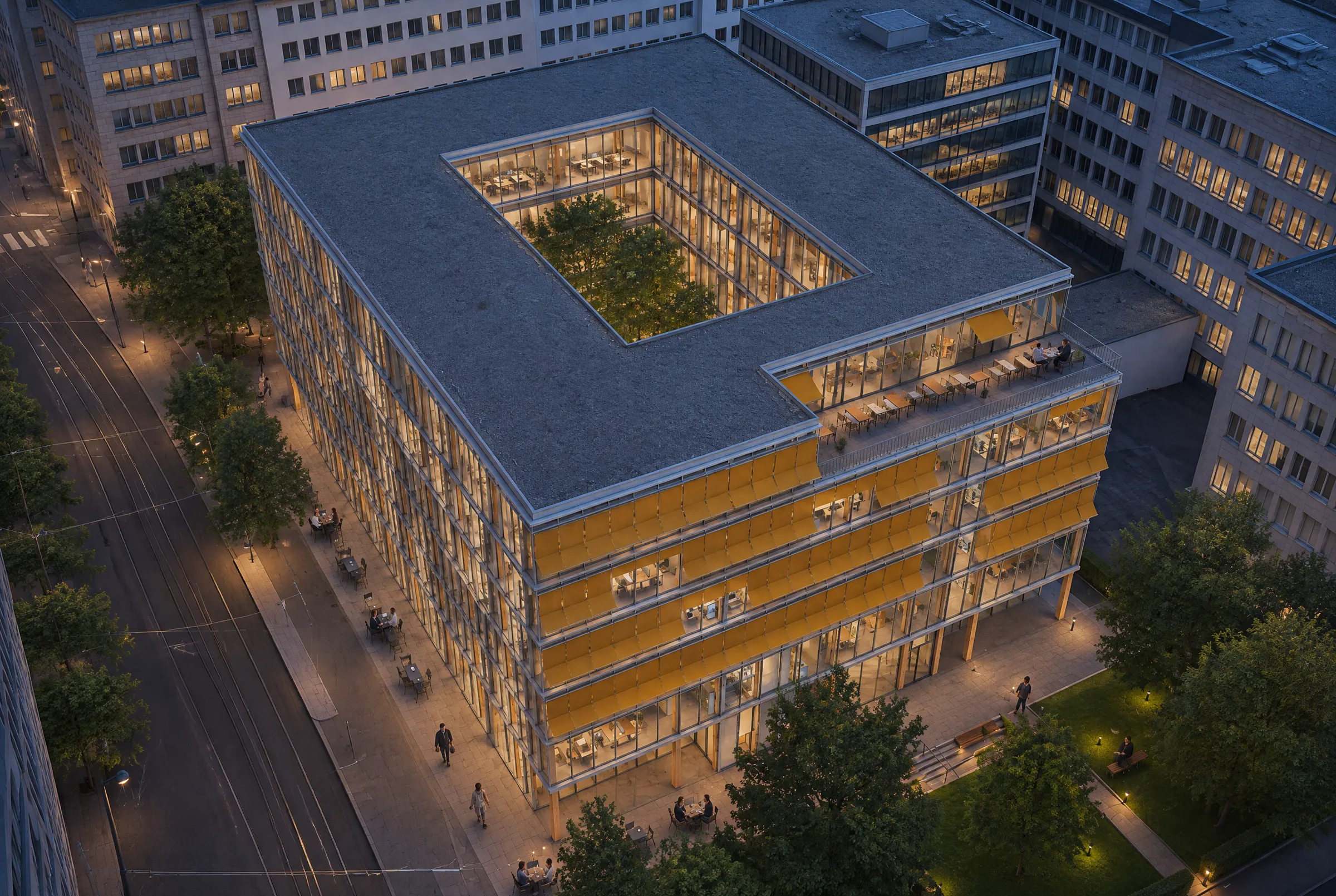
The three-date top view shows the roof and the court floor only: in that view the viewer draws no ground grid around the building, so the ground is left out rather than shown as 0 hours. The court sun-and-shadow clip comes from the first run of this study, on 14 November, before the viewer drew the right credits, so it was recorded without legend and clock.
How it was made: the office model was exported from Revit to IFC. The 141 surrounding buildings were read from the context masses in the Revit model and written into the IFC model as simple extruded masses with ifc_run_write_task: 119 come from swissBUILDINGS3D 3.0 (footprints with their maximum roof height), and 22 are neighbouring buildings surveyed for this sample model. They cast shadows and are not analysed. None of them stands inside the office.
What it shows, as averages over each facade: on 21 June the south-east facade gets 6.7 hours of direct sun, the south-west 6.1, the north-east 4.1 and the north-west 2.8. On 21 March it is 5.2, 4.2, 2.2 and 1.0 hours. On 21 December the south-west facade gets 1.6 hours, the south-east 1.5, the north-east 0.3 and the north-west none, and the sun reaches mostly the upper storeys: of the facade cells below 5 m, 4 of 308 see any sun that day. The court floor gets sun mainly in summer: 146 of its 520 cells see some sun on 21 June, 8 on 21 December.
Limits
- Early-stage study, not a daylight or rights-of-light assessment.
- Surrounding buildings are simple blocks at their maximum roof height; trees and terrain are not modelled.
- Sun hours are counted per grid cell from one point at its centre, every 30 minutes.
- This run used a build of Archi Automate that is not released yet, so the page is marked “In development”.