AI renders can change geometry: compare with the model view. Composition guided by the model view. Use the comparison below.
Compare with the model view
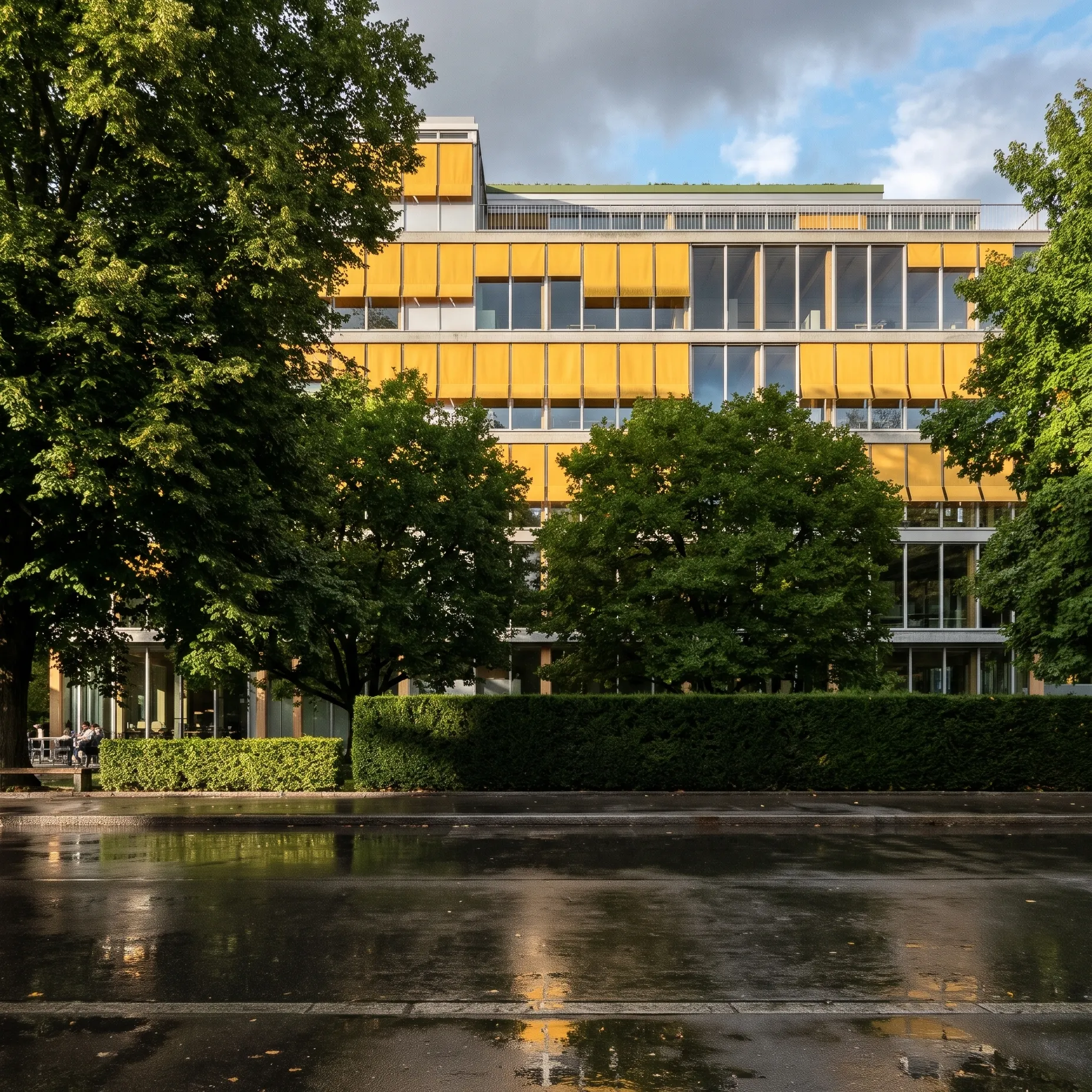
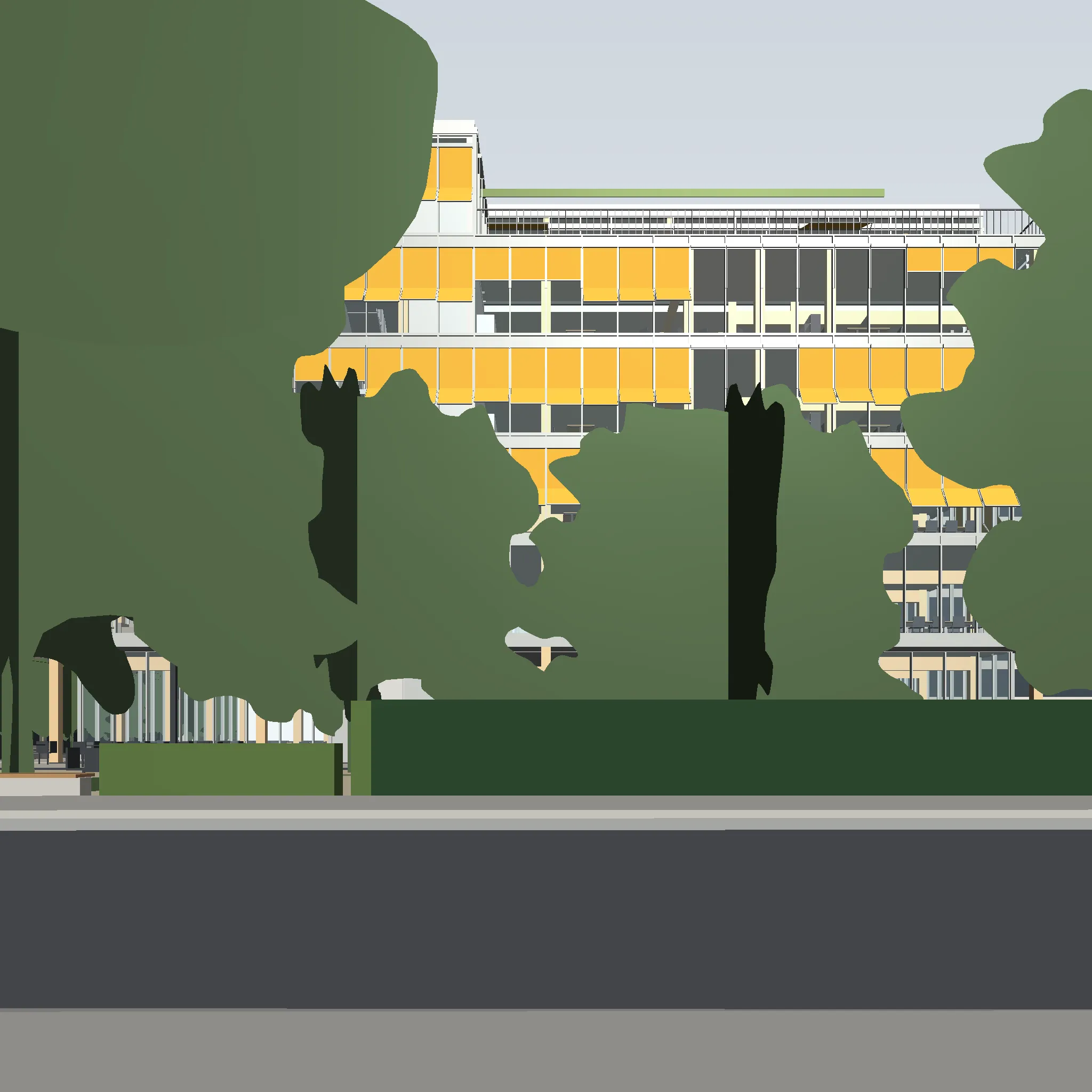
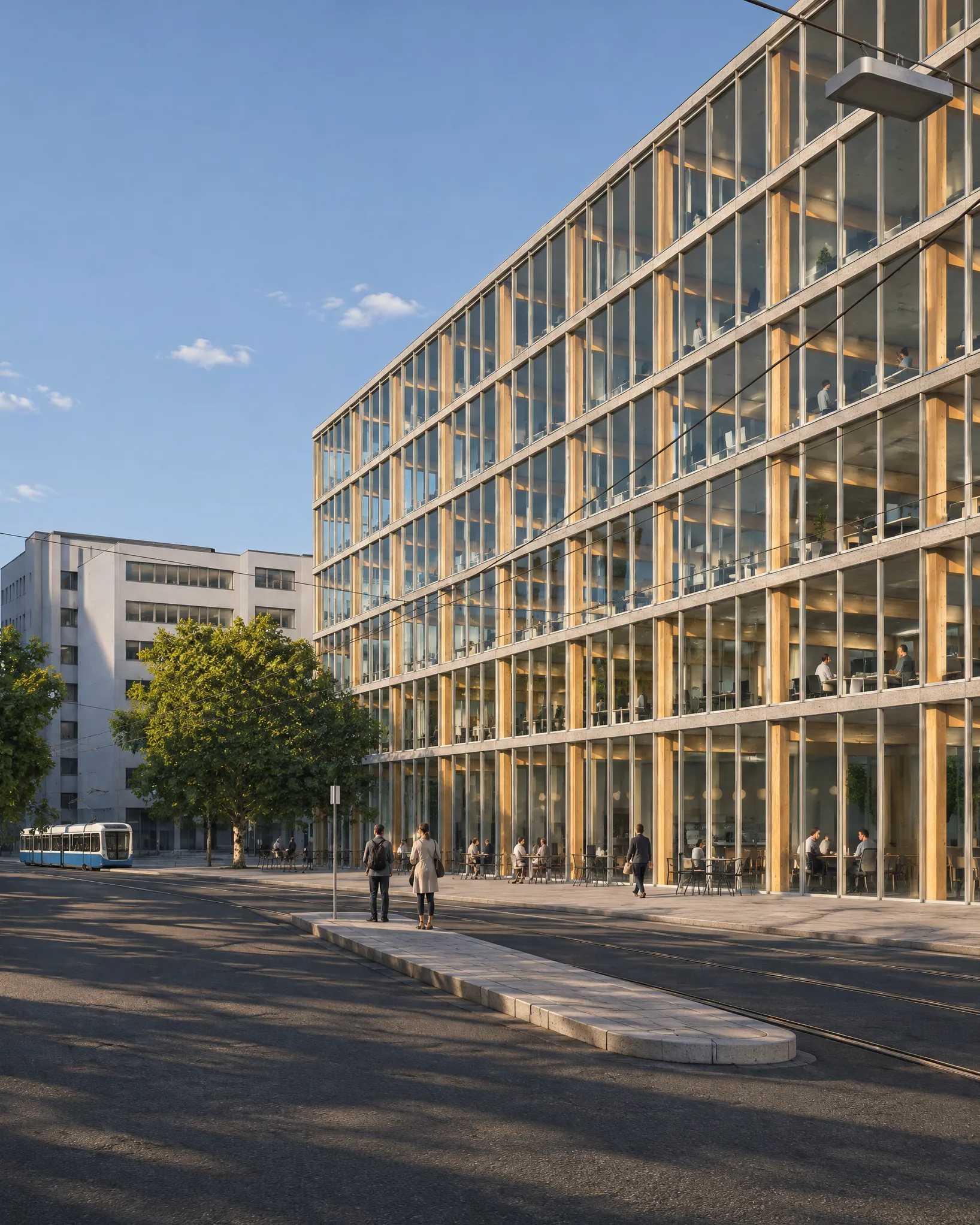
Zurich office · Garden façade after rain
AI-generatedRevit → Nano Banana 2.1
Ask your AI assistant
Take the Revit 3D view of the garden façade and render it with Nano Banana 2.1, just after a September shower.
Show the full prompt
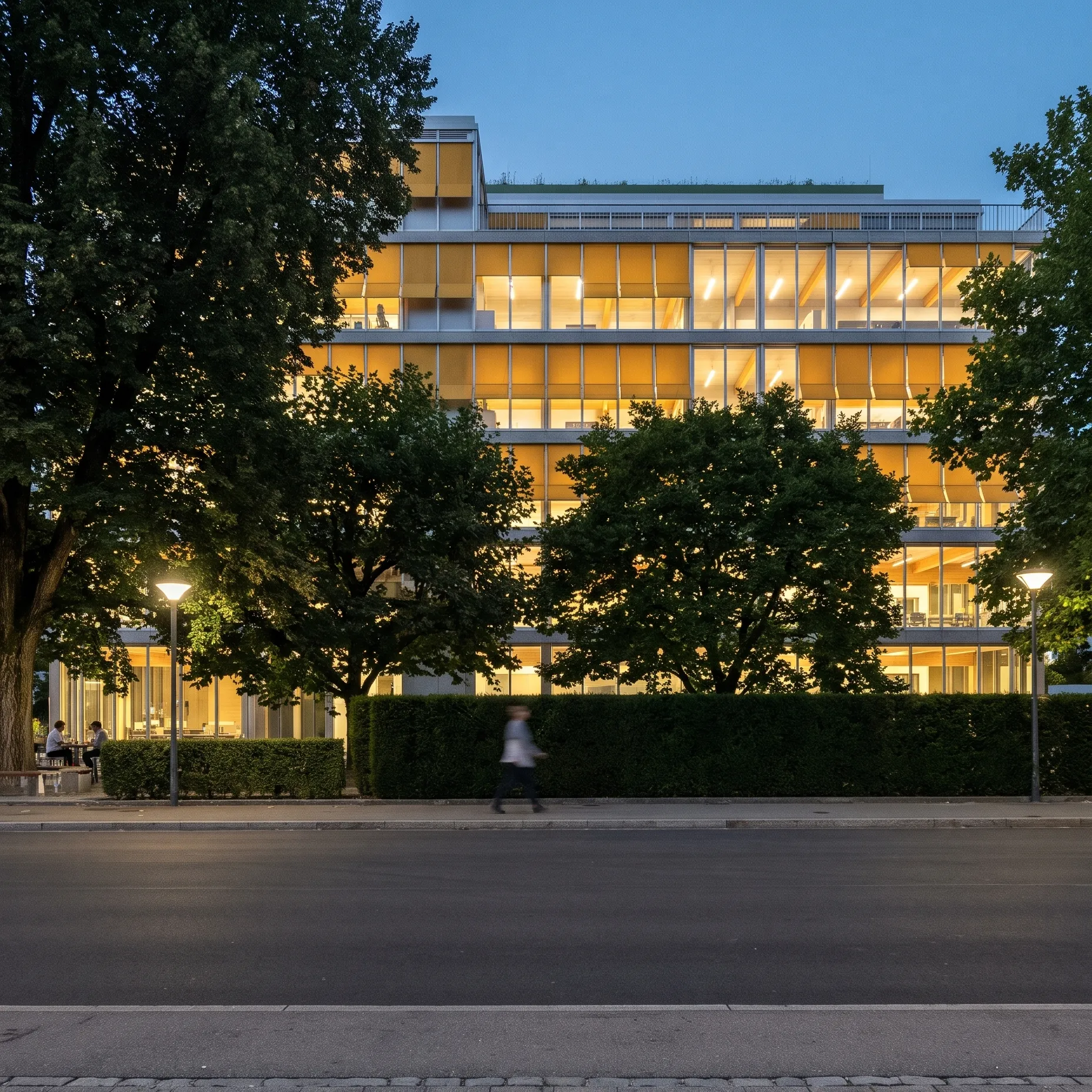
Using the Archi Automate MCP, take the Revit 3D view [the garden façade, seen across the street through the trees] as the reference image and render it with render_view on [Nano Banana 2.1], with this image prompt: Camera: keep the input camera exactly. A level camera 1.0 m above the pavement of a quiet street, 4:5 portrait, looking straight across the street at the garden front of an office building seen through a grove of trees; horizon a little below the middle of the frame, verticals vertical, one-point perspective. Do not raise, move, tilt or widen the camera. The trees are the first thing to keep. The garden grove in front of the building is old and big, 12 to 16 m tall, with broad, dense, low crowns, and in this view it hides most of the lower half of the building, exactly as the green cut-outs in the input do. The big tree on the left fills the whole upper left of the frame, from the top edge down to the hedge and from the left edge across to about 40 % of the width, so the left end of the building is hidden behind its leaves. Two more broad crowns stand in the middle in front of the lower floors, from about 27 % to 85 % of the width, rising from the hedge up to the third-floor awning row. A tree at the right edge covers the right end of the facade from near the top floor down to the hedge. Between these crowns only the top two floors read clearly across the width, plus the small gaps the input shows. Each crown keeps the size, outline and position of its cut-out; do not shrink, thin, lift or trim any tree to show more of the building. Photographic architectural image, made to read as a real photograph, in which the garden and the weather are the protagonists. Shot on a full-frame camera with a wide-angle lens, held level, f/8, 1/125 s, ISO 200: natural depth of field, fine film-like grain, true photographic detail in leaves, bark, wet stone, fabric and glass. One decisive moment of light and weather: a late September afternoon, the rain has passed. The shower is over and no rain is falling. The pavement, the kerb and the street are still wet and shine, with puddles in the foreground that mirror the trees, the facade and the sky, and a few fallen leaves stuck to the wet stone. The sky is breaking: the grey cloud deck is tearing open above the building into bright patches of blue, and the low sun, behind the camera, breaks through and rakes across the upper facade and the awnings, with long, crisp shadows of the trees. Drops still hang on the leaves. Rich, natural colour, not boosted; strong but believable contrast, dramatic but true. Quiet, specific to this place and this minute. A full photographic tonal range: the sunlit awnings, the sunlit slab bands and the bright breaks in the sky and their reflections in the puddles are the brightest tones, close to white without clipping, while the shade under the big tree crowns and the tall hedge goes down to deep, clean near-black. Building: a Zurich office building, a calm curtain wall of natural silver anodised aluminium mullions and a grey exposed-concrete slab-edge band at every floor, with clear glass and light honey-coloured timber posts just behind the glass; exposed light concrete soffits with honey-coloured glulam beams are visible inside; a setback top floor with a slim metal railing and a green roof edge. Many windows of this garden facade have curry-mustard fabric window awnings, in mixed states exactly as modelled in the input: most angled out, some bays with none (rolled up). The awnings keep exactly the input's groups and gaps: each awning is a separate panel over its own window, with the frames between them and the bare bays where the input shows bare bays; never merge them into continuous bands. Render each as taut matte curry-mustard woven awning fabric on slim metal arms, darkened a little at the hem by the rain, exactly where it is and in the same state. Add no awnings where the input shows none, none on the bays hidden behind the tree crowns, and no blinds, screens or awnings on the ground floor. The input is a simplified Revit model, and some things in it are placeholders. Render them as what they stand for, not as they look: - The flat green cut-out shapes with dark trunks are placeholders for real mature deciduous trees of the garden grove, hornbeam, maple and lime, with dense late-summer leaves, each exactly as large as its cut-out. - The flat dark-green box is a placeholder for a tall clipped yew hedge; the lower lighter green box is a clipped hornbeam hedge. - The dark grey band across the lower part of the frame is the wet asphalt carriageway; the plain grey area at the bottom is the pavement: render it as wet stone paving. - The pale grey flat sky is a placeholder; render the sky of this moment. - There are no shadows in the input; add the shadows this light and the trees would cast. People: one or two tiny figures at true scale far away, at the cafe tables at the left edge behind the low hedge. Nobody looks at the camera; nobody is the subject. The sun is low in the south-west, behind the camera and a little to the right, and out of frame. There is no sun disc in the sky, no sun glow, no sunburst, no rainbow and no lens flare anywhere in the image. The skyline is a flat city horizon: only the buildings that are in the input. No invented landmarks, towers, church spires, wooded hills, mountains, masts, cranes or chimneys on the horizon. No text, signs, logos or advertising anywhere. Treat the input image as the exact geometry and camera. Keep every building element exactly where it is: the outline of the building, the setback top floor with its railing, the number, spacing and thickness of the mullions, transoms, timber posts and slab bands, the floor edges, every window awning in its place and state, the tall clipped hedge and the low hedge, the kerb and the pavement. Keep the horizon height and the frame exactly as in the input. Do not add, remove, move, bend or resize any part of the building. Do not add floors, balconies or any sun shading beyond the awnings already in the input. The mood changes only light, sky, weather and atmosphere. Last check before you finish: every tree crown is as big as its cut-out, the left tree fills the upper left down to the hedge, and the middle crowns hide the lower floors; never smaller or thinner trees. Avoid: falling rain, a downpour, a storm, umbrellas, flat light, washed-out or pastel grading, grey lifted shadows, an illustrated or painted look, CGI plastic surfaces, the flat cut-out look of the input trees, small, young, thin or trimmed trees, a clear unobstructed view of the whole facade, awnings merged into continuous bands, awnings removed, glossy or plastic-looking awnings, awnings on bays where the input has none, blinds on the ground floor, people posing or looking at the camera, crowds, neon or oversaturated colour, halos and HDR tone-mapping artefacts, a sun disc or sun glow, a sunburst, a rainbow, lens flare, invented landmarks, towers, hills or masts on the horizon, text, signs, logos, advertising, street names or watermarks, cars.
The garden façade of the Zurich office, a sample Revit model, behind its big trees across a wet street just after the rain, the sky breaking with sun. AI-generated: rendered by Google Nano Banana 2.1 from a Revit 3D view with flat green cut-out trees and no weather.
- Engine
- Google Nano Banana 2.1
- Input
- Revit
- Time
- 57 s
- Cost
- $0.131 (metered estimate)
- Date
- 2026-11-14
- Tools
- Revit → render_view
- MCP calls
- render_view
Method notes
AI-generated image · Google Nano Banana 2.1. Not a photograph. Not a built project. This is a render of the Zurich office, a sample model made in Revit through the Archi Automate MCP. It is not a building that was built, and Archi did not design a real building here.
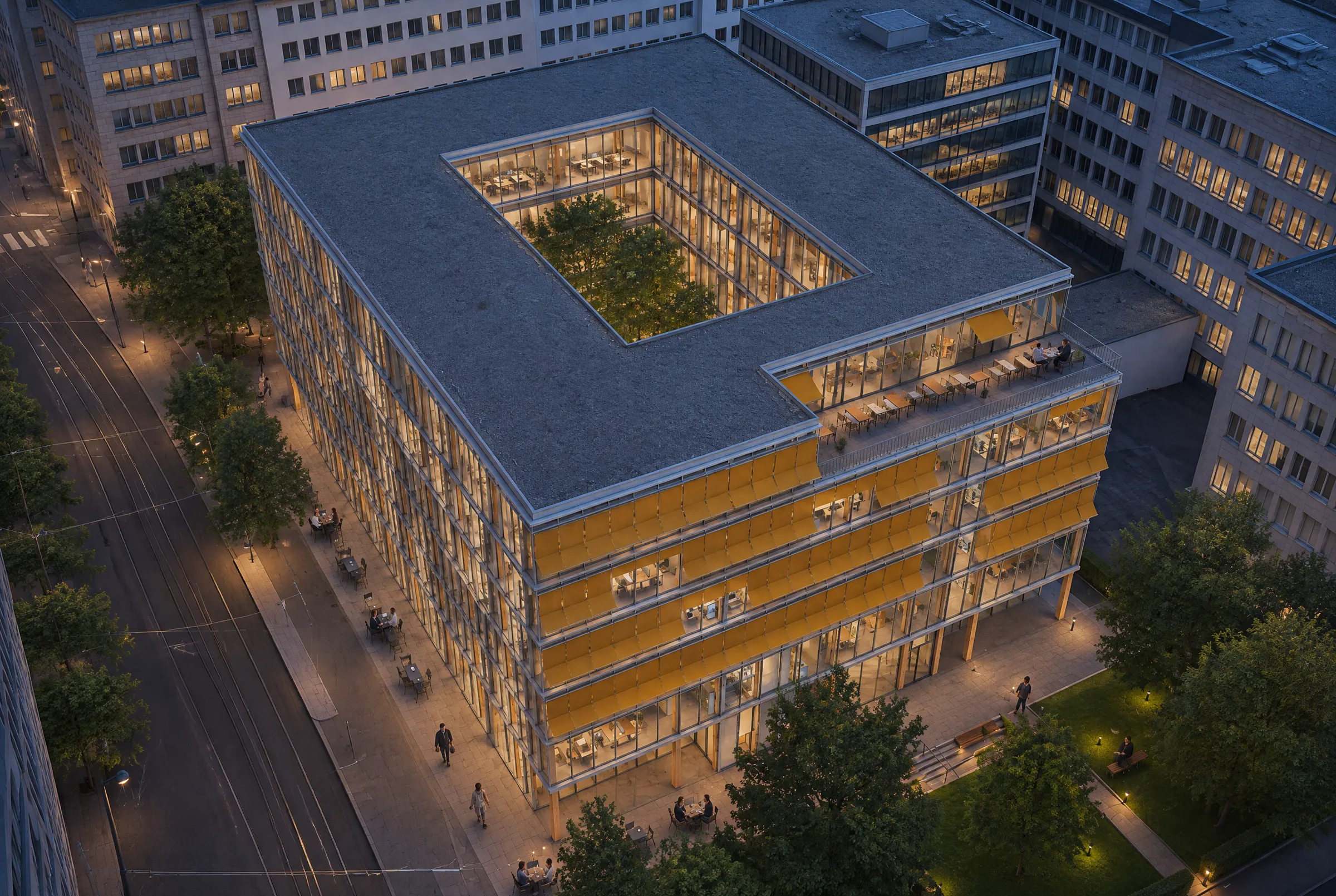
Full Tone. Full colour and real depth: the building in one chosen moment of light. Full Tone reads like a camera image. Natural two-point or axial framing at a believable eye height, true depth and a fine film-like grain. Each image commits to one clear light: hard summer sun with crisp shadows, golden hour raking across the façade, or blue hour with the offices glowing from inside. The moment and the mood carry the image.
How it was made. Google Nano Banana 2.1 rendered this image through Archi Automate’s render_view, from a Revit 3D view of the sample model. The view was exported from Revit and sent as it was. The result and the Revit view were then both cropped to a square (square, top kept) with a script outside Archi Automate, so the comparison lines up. It is a restyled view, composition guided by the model view, not a record of the model.
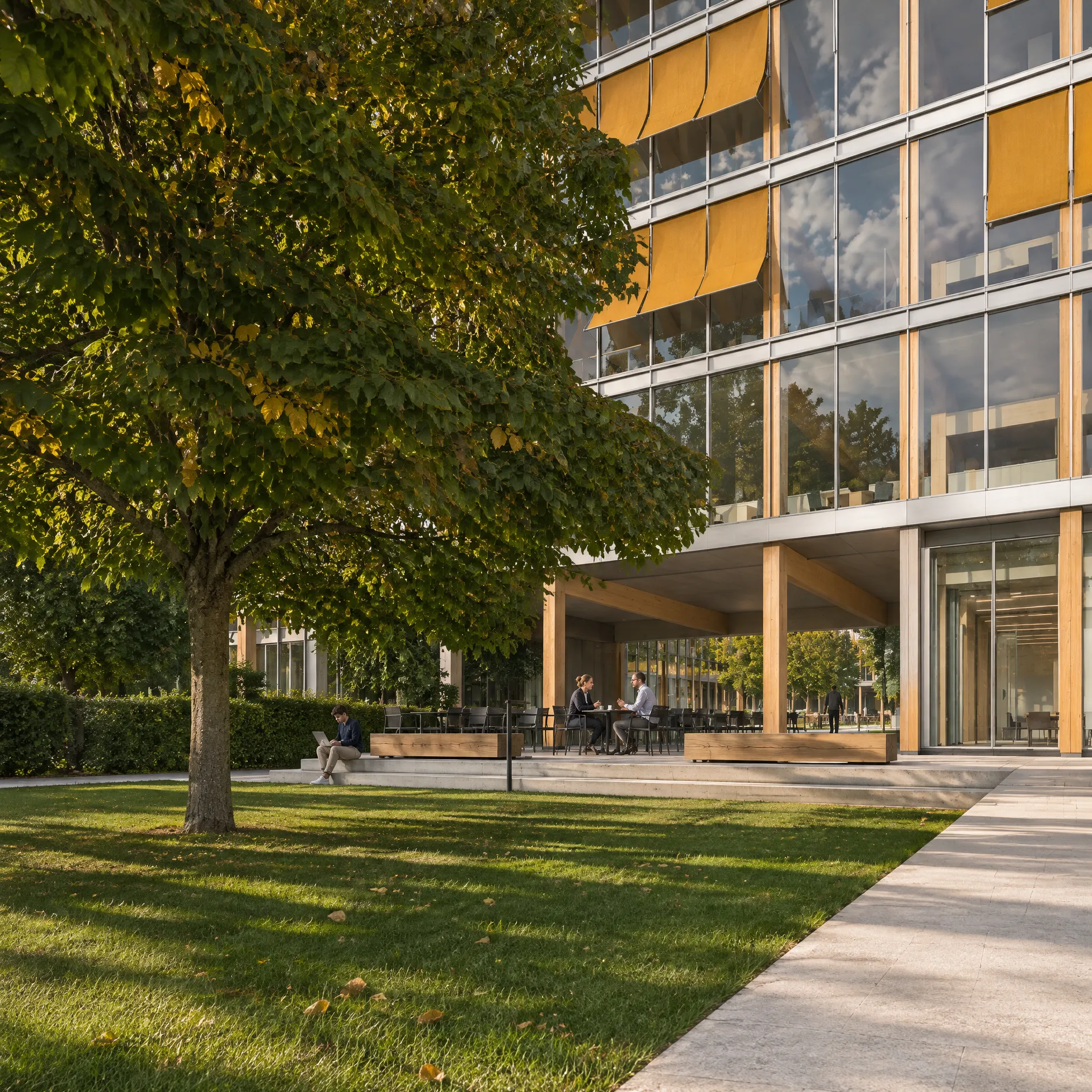
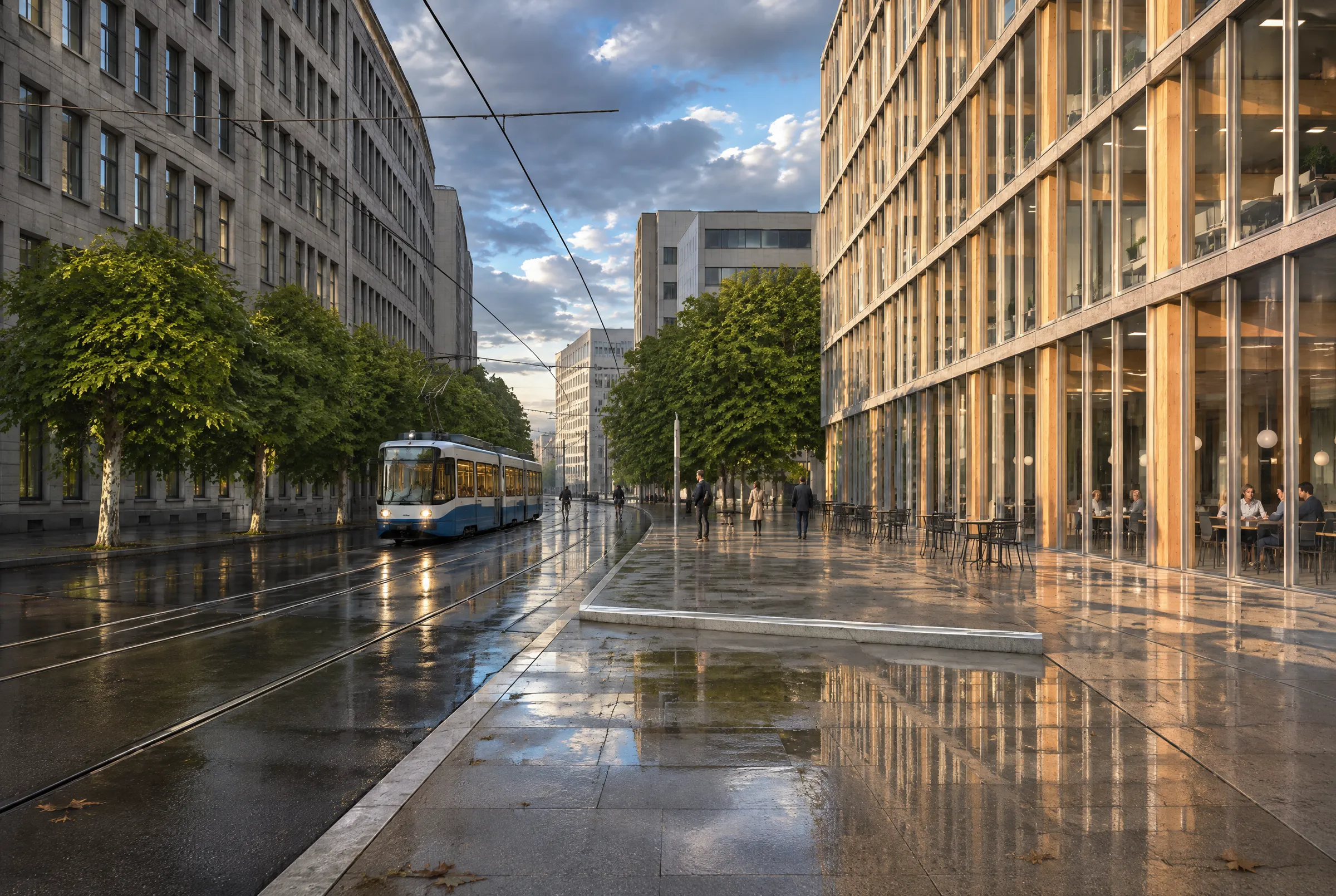
Added by the render, not in the model view: the wet street with its reflections and puddles, the breaking sky, the leaves of the big trees (the model has flat green placeholder crowns), the clipped hedges, and a few people at the café tables. The people are generated by the image model and are not real.
The image on this page is re-encoded for the web. Compare it with its Revit view before relying on a detail.