Screening study, steady RANS — not a planning report.
Fast assessment: wind from 240° (WSW), 60° (ENE), 30° (NNE) and 210° (SSW) only (4 of 12 directions). Speed-up at 1.5 m compared with the approaching wind at the same height. Other directions can make other places windy. No comfort or safety classes. A normal run (all 12 directions) gives screening comfort classes. Wind from 210°: not fully settled; shows windy and sheltered zones, do not quote values. Speed-up = wind at 1.5 m ÷ the approaching wind at 1.5 m; 1.0 = the same as the approaching wind. A ratio for one direction, not m/s.
The speed-up field, wind from 240°
Zurich office · Pedestrian wind
Viewer recordingswissBUILDINGS3D → wind, quick look
In a fast quick look, one wind direction at a time, the wind at 1.5 m around the Zurich office is mostly well below the approaching wind: the median speed-up is 0.31 for wind from 240° (WSW), 0.37 from 60° (ENE) and 0.31 from 30° (NNE). A few places speed up; the highest values are 1.63, 2.08 and 1.09, the most in wind from 60°. Wind from 210° is not fully settled, so it has no values, and the court has no data.
Good for finding, before a wind consultant is brought in, the corners where entrances and terraces may need attention. It gives no comfort or safety classes: four of 12 directions were run, and other directions can make other places windy.
Ask your AI assistant
Run pedestrian wind CFD around an IFC office with OpenFOAM for four directions and map speed-up at 1.5 m.
Show the full prompt
Using the Archi Automate MCP, export the scene of [the office] with its surrounding buildings from the IFC model and run sim_wind in fast mode for wind from [240°, 60°, 30° and 210°], over a study area of [120 m] radius around the building, with true north [62.8°] and the massing set down on the flat CFD ground. Show the speed-up at 1.5 m in the Archi Automate viewer with moving wind trails, seen from [the south-west] and from above, with the neighbouring buildings hidden so the streets can be seen; capture frames and record a short film that steps through the directions.
- Engine
- Claude (assistant). No image or video model; the colours are the computed speed-up.
- Input
- IFC
- Time
- sim_wind 66.6 min for the four directions, one after another on one core each (solve 34.8 min for 240°, 2.5 min for 60°, 11.9 min for 30°, 13.3 min for 210°), with other simulations running on the same PC; viewer_record 12 s
- Date
- 2026-11-15
- Tools
- IFC → sim_wind → viewer_record
- MCP calls
- ifc_job_submit → export_scene → engine_status → sim_wind → ifc_job_status → viewer_show → viewer_set → viewer_capture → viewer_record
Method
Archi Automate output, unretouched. sim_wind ran in fast mode: one steady RANS solution in OpenFOAM v2606, which is installed separately, for each of four wind directions, 240° (west-south-west), 60° (east-north-east), 30° (north-north-east) and 210° (south-south-west). The meshes had 241,000 to 245,000 cells. The directions ran one after another, each on one core, in 66.6 min in all. sim_wind samples the speed-up every 2 m, 1.5 m above the ground, within 120 m of the office, about 5,560 points with a value per direction. Speed-up is the wind at 1.5 m divided by the approaching wind at the same height, so it is a ratio for one direction and not m/s. Fast mode is labelled as such in the results, on every frame and in the film.
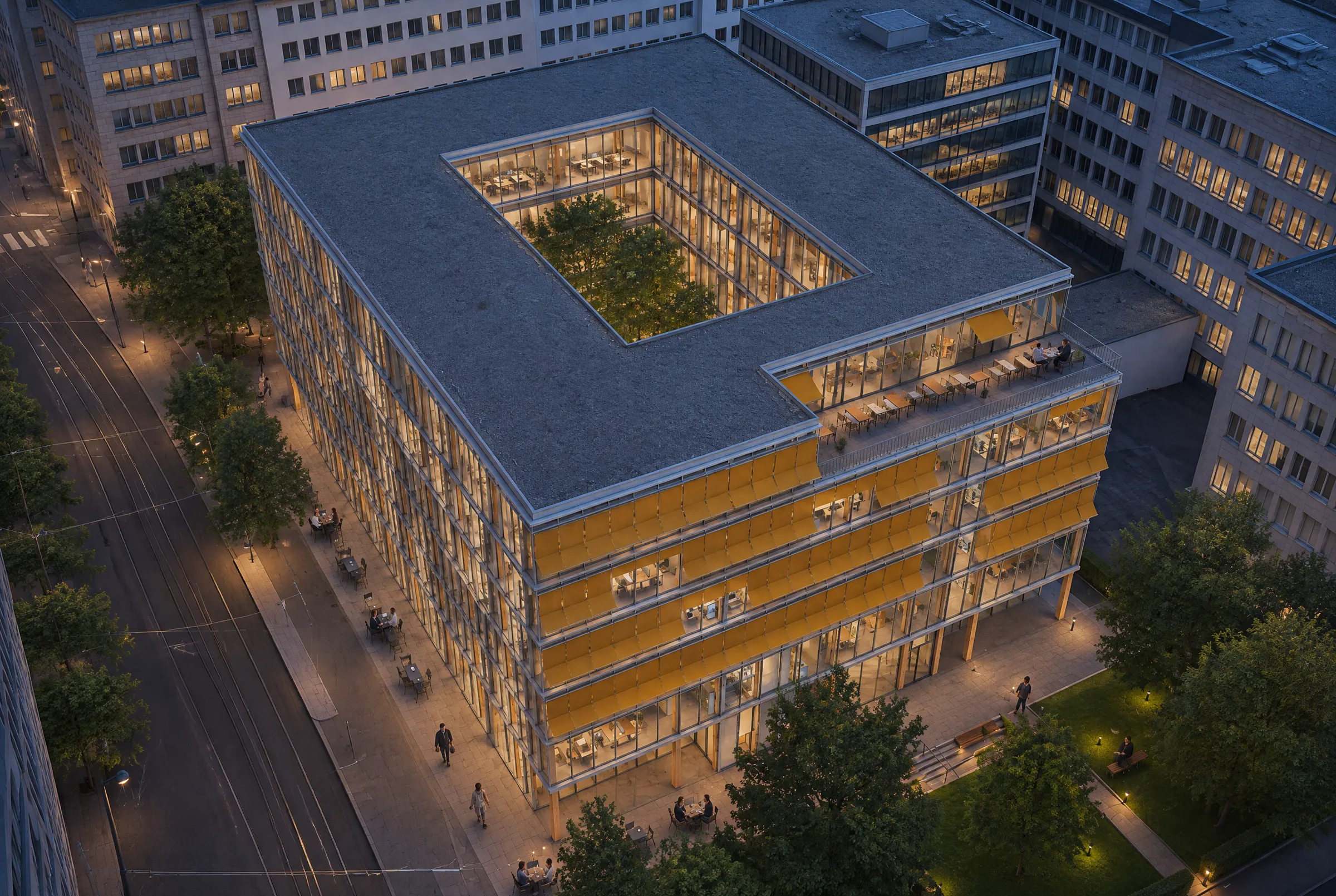
How it was made: the scene is the IFC model of the office with its 141 surrounding buildings (119 from swissBUILDINGS3D 3.0, 22 surveyed for this sample model), exported with export_scene. sim_wind turned it into solid massing, voxelised at 1.5 m, and set the office and 13 context parts down onto the flat CFD ground. At that resolution it closed 91 narrow passages that the design leaves open; the viewer marks them and shows a “Not the solved geometry” warning. The neighbouring buildings are hidden in the frames so the streets can be seen; their footprints show hatched.
What it shows, one direction at a time (the directions are not combined): over the study area the median speed-up is 0.31 for wind from 240°, 0.37 from 60° and 0.31 from 30°; nine in ten points stay below 0.78, 0.90 and 0.66, and the highest values are 1.63, 2.08 and 1.09. Wind from 210° is not fully settled, so its values are not quoted; the film shows it only as windy and sheltered zones. The office court has no value: the run counted it inside the massing, so it shows hatched, and it is not calm.
Limits
- Screening study, steady RANS — not a planning report.
- Fast mode: four wind directions of 12. No yearly statistic, no comfort or safety classes, no gusts, no seasons. Other directions can make other places windy. The directions are not combined into a site result.
- Wind from 210° is not fully settled: windy and sheltered zones only, no values.
- Speed-up is a ratio to the approaching wind at 1.5 m, not m/s at a point.
- Massing voxelised at 1.5 m on flat ground: narrow passages are closed, terrain and trees are not modelled, and the office court has no value. Nothing farther than about 250 m from the office is modelled.
- No accuracy is claimed for this site.
- This run used a build of Archi Automate that is not released yet, so the page is marked “In development”.
- Voxelisation left 91 narrow passages closed in the solved massing, although the displayed design leaves them open.
- The trails’ pace is set for legibility, not elapsed time; their paths follow the computed flow, and this fast run used no weather data.