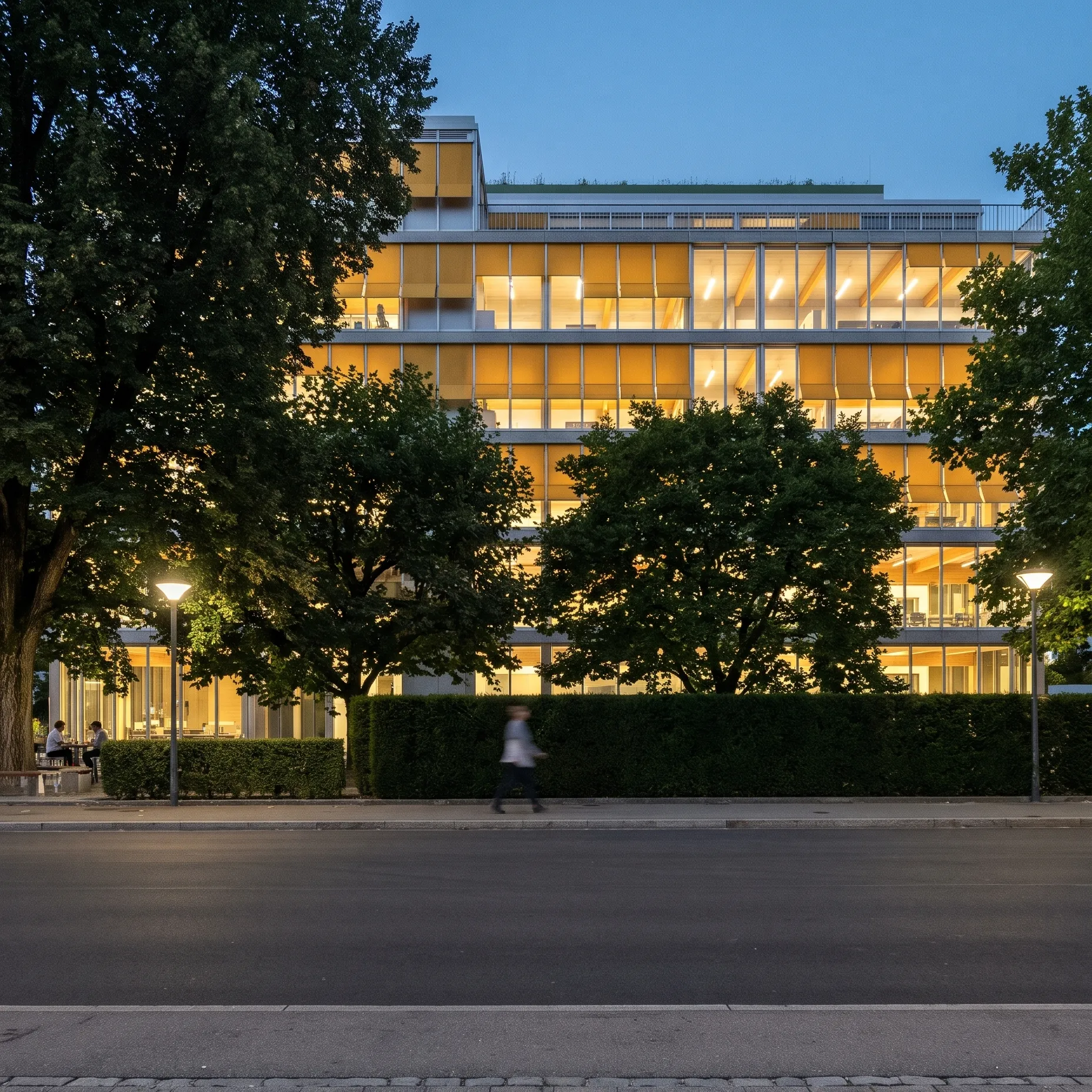
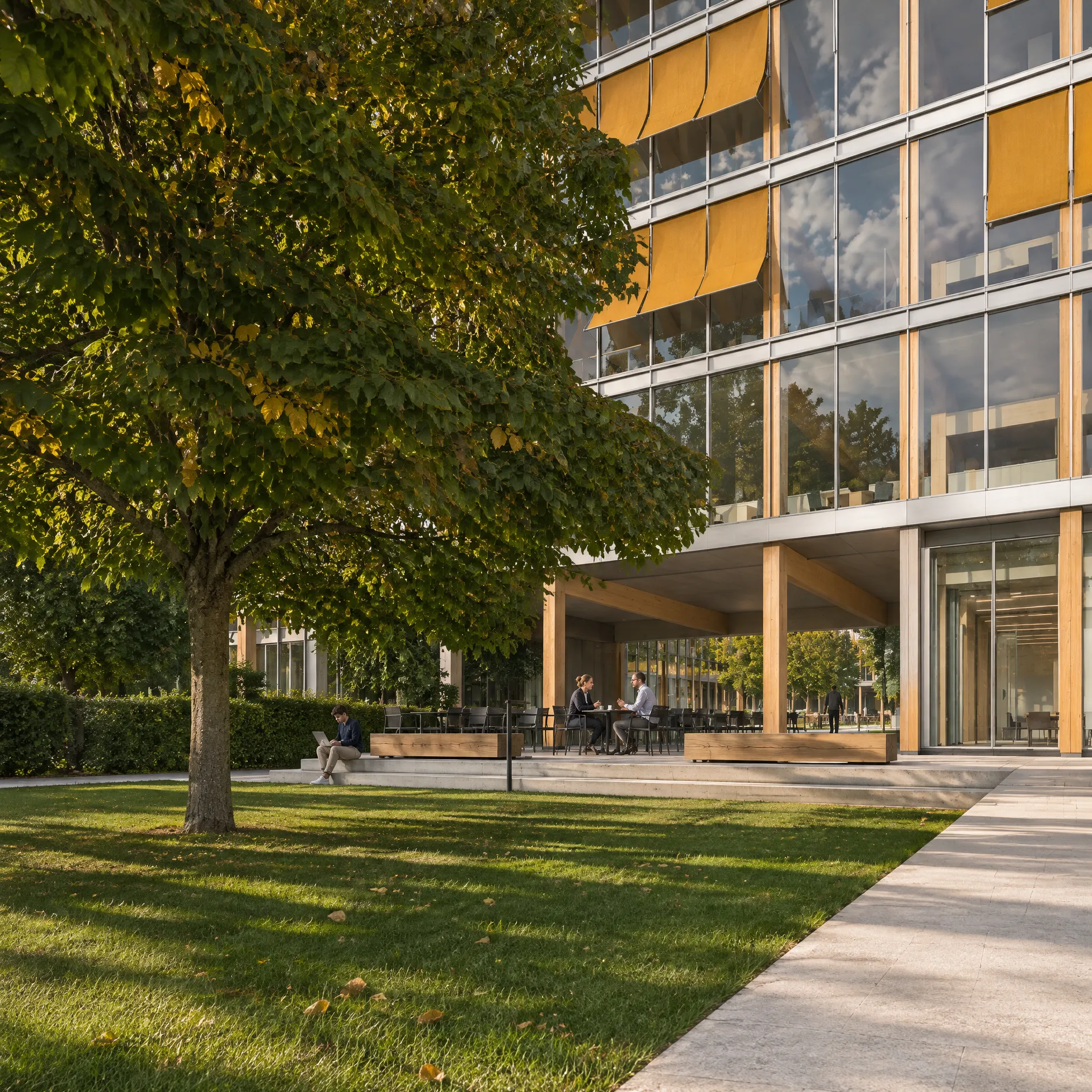
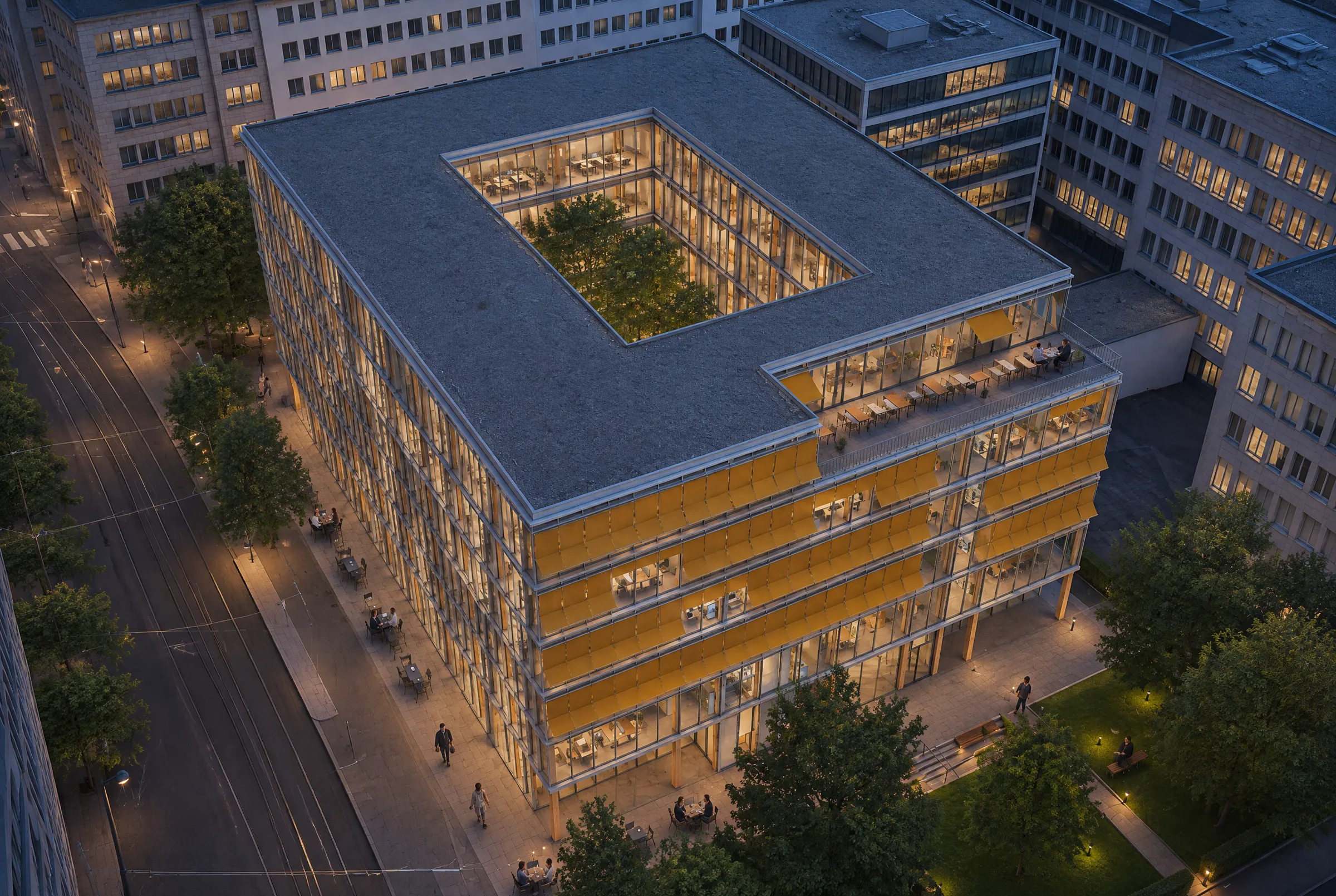
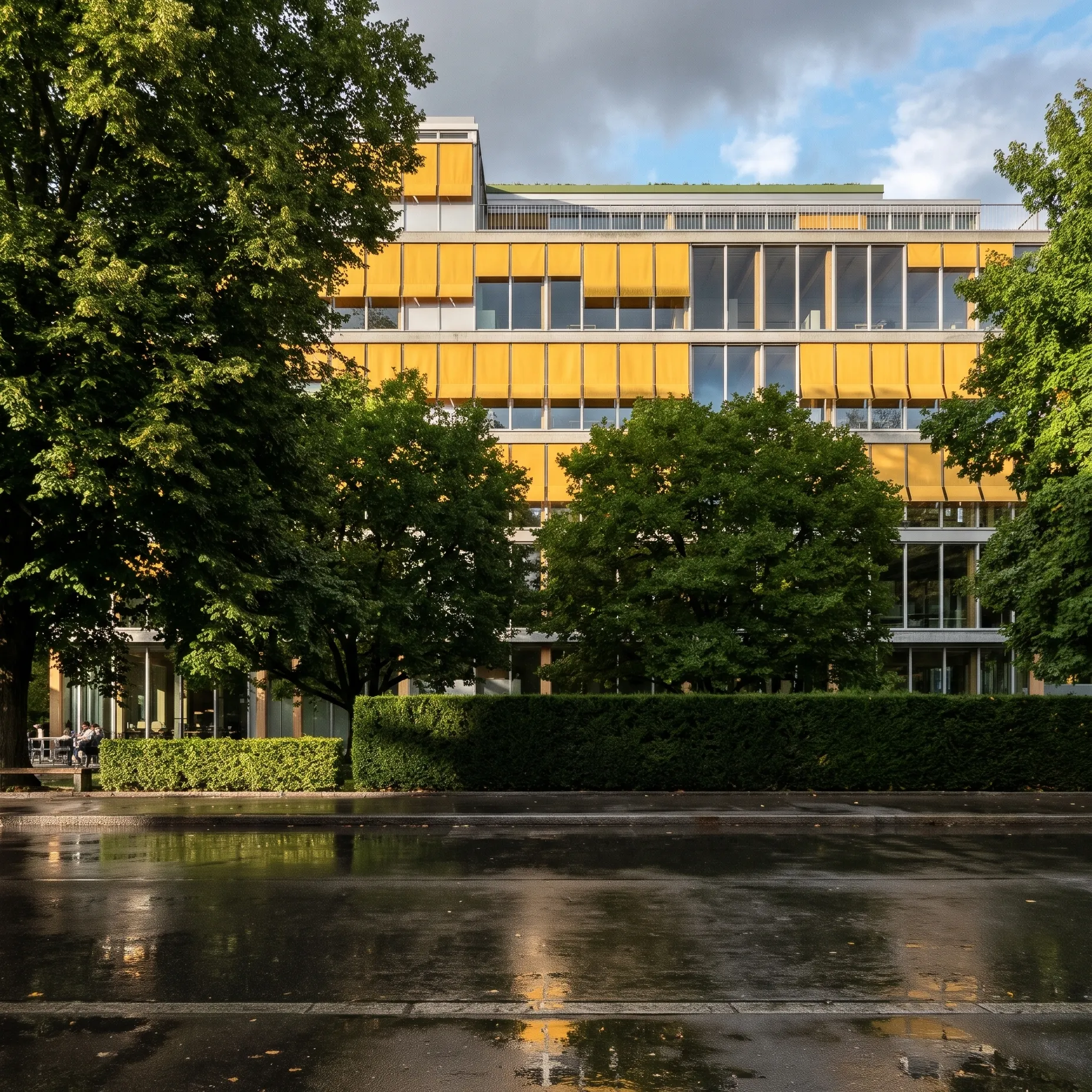
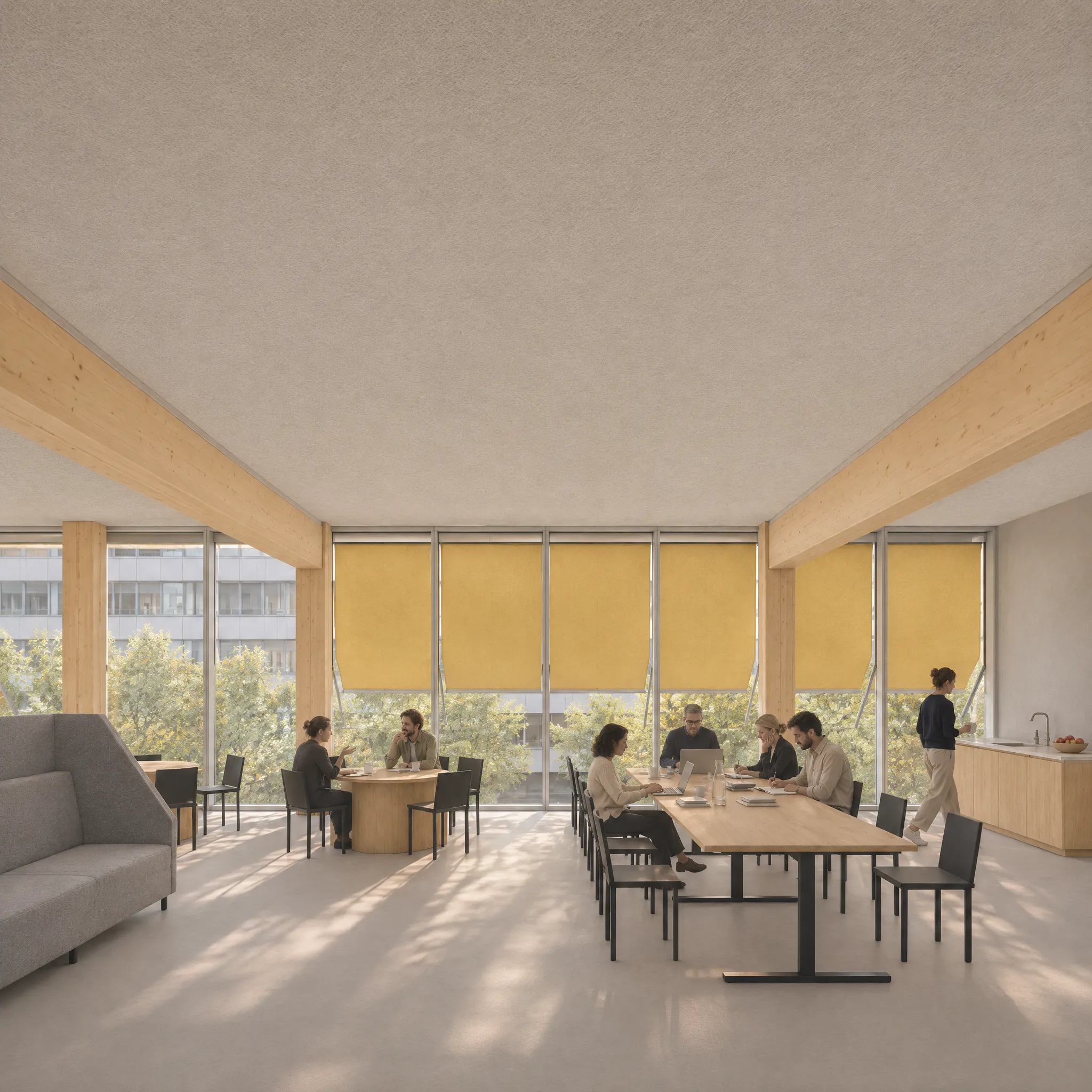
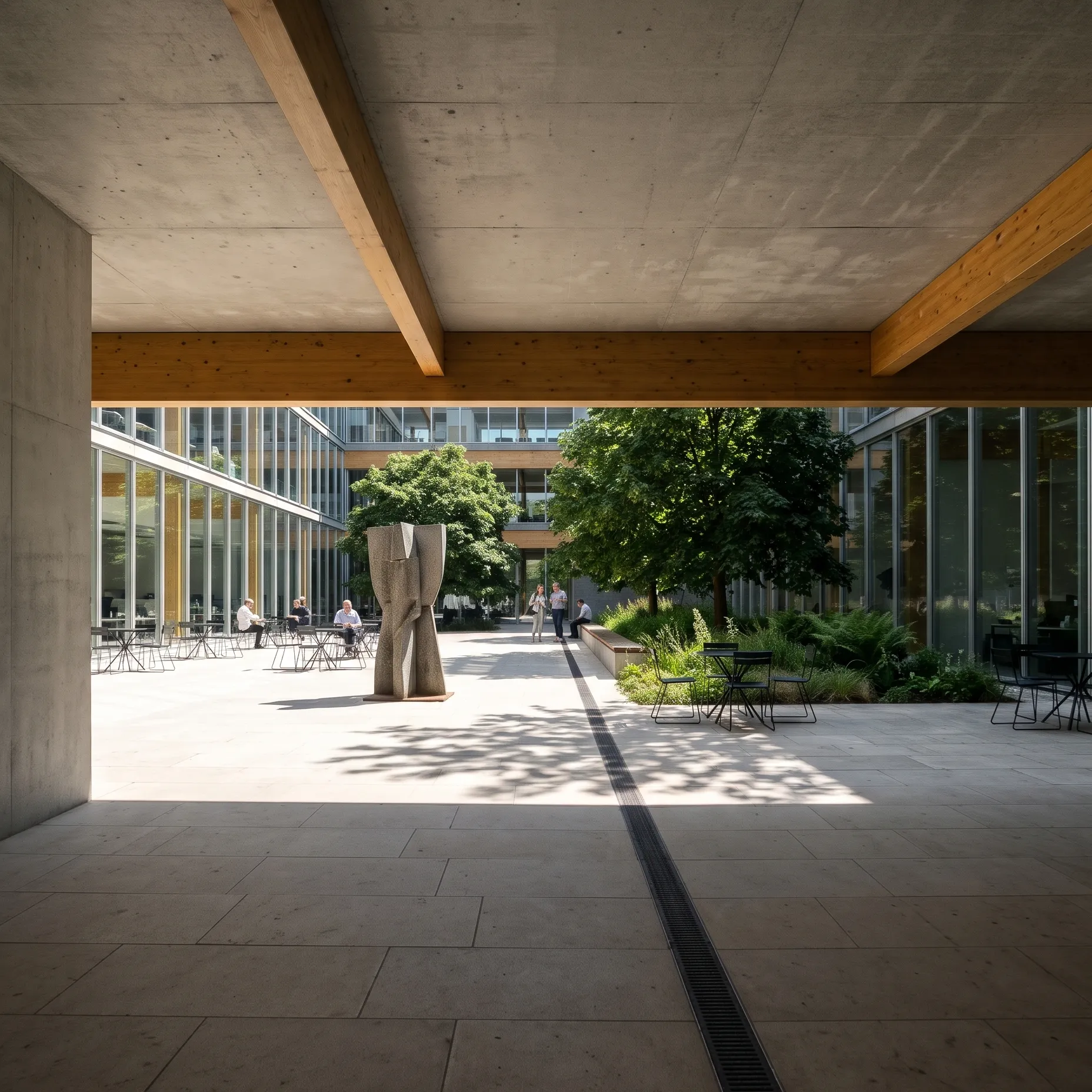
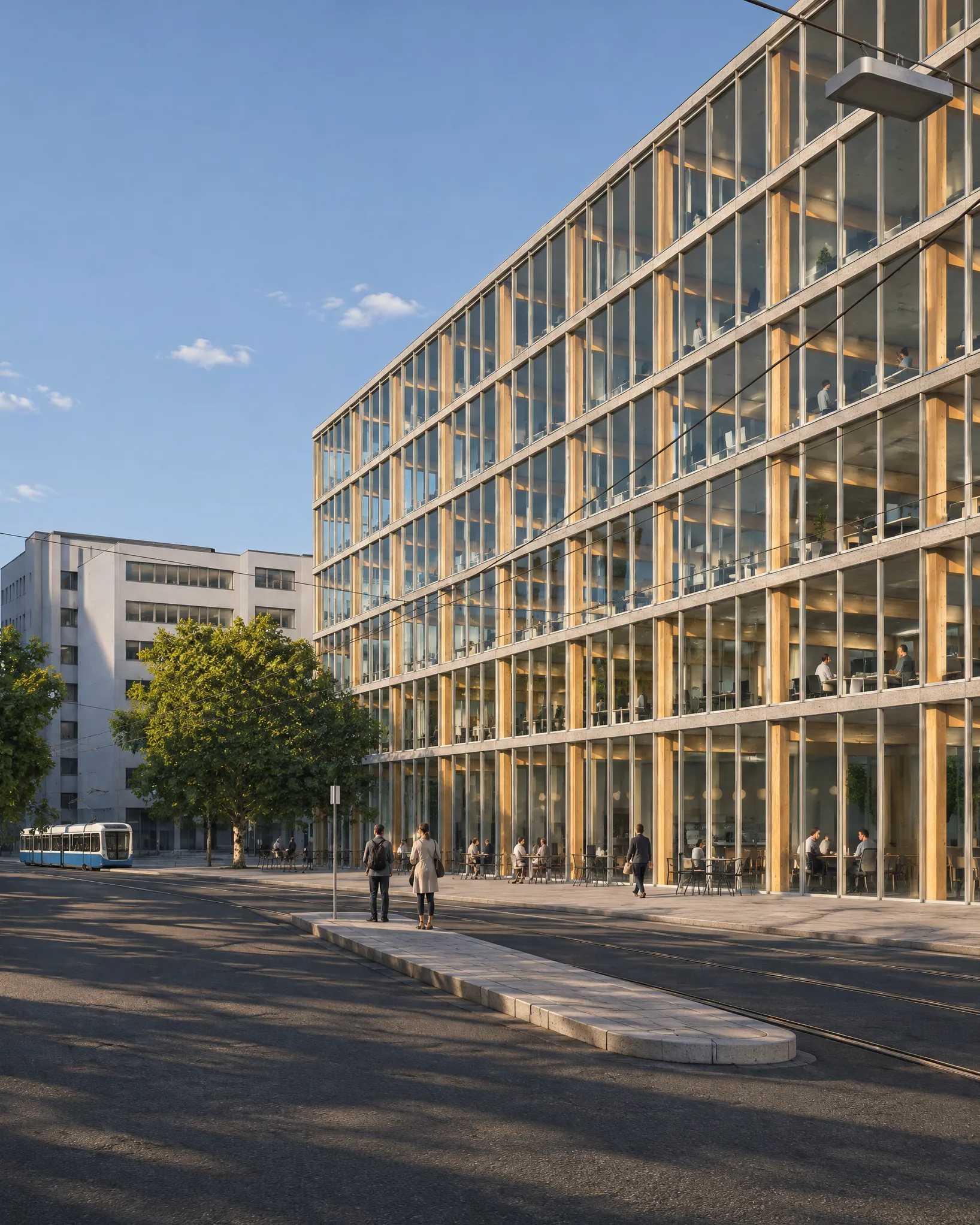
AI renders can change geometry: compare with the model view. Composition guided by the model view. Use the comparison below.
Compare with the model view
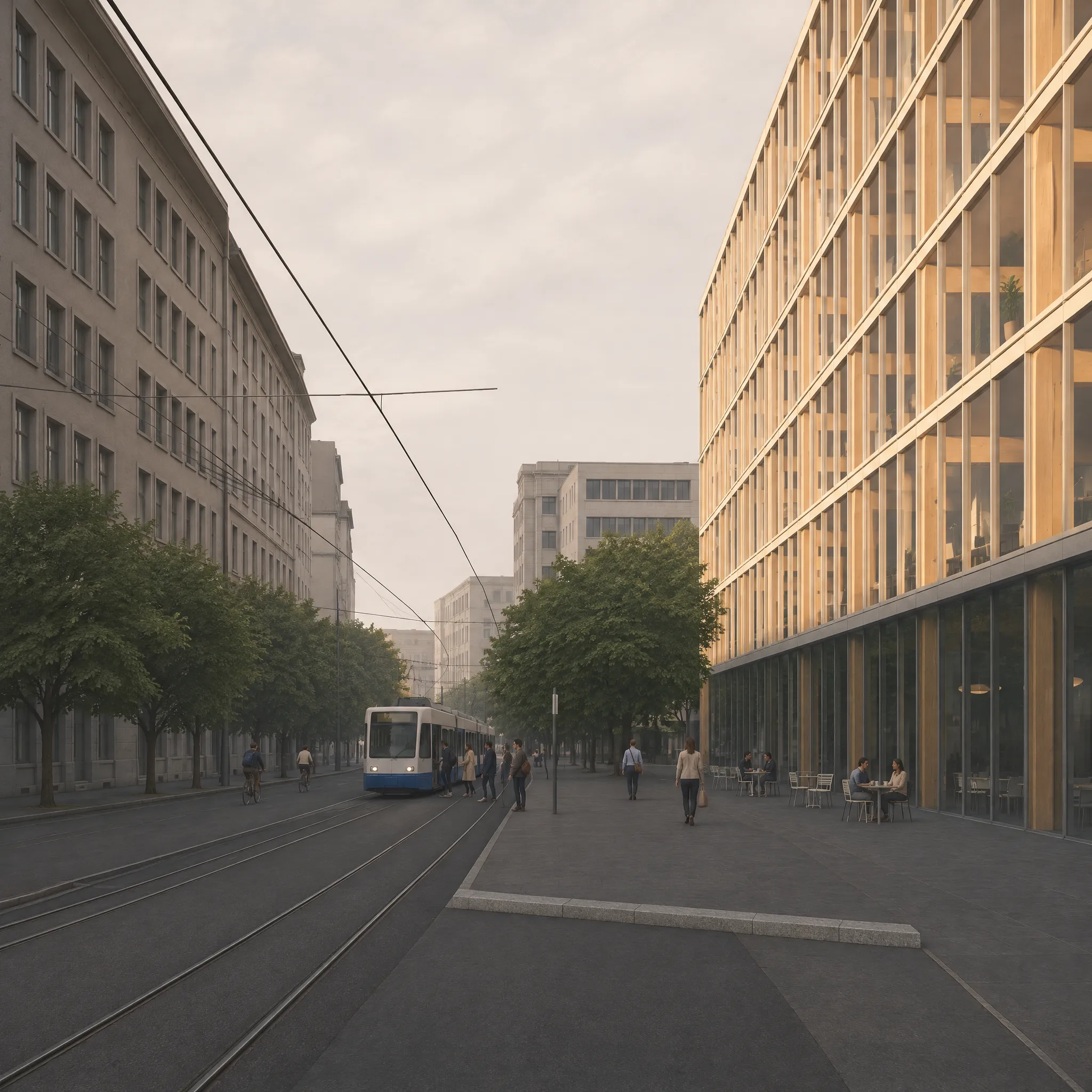
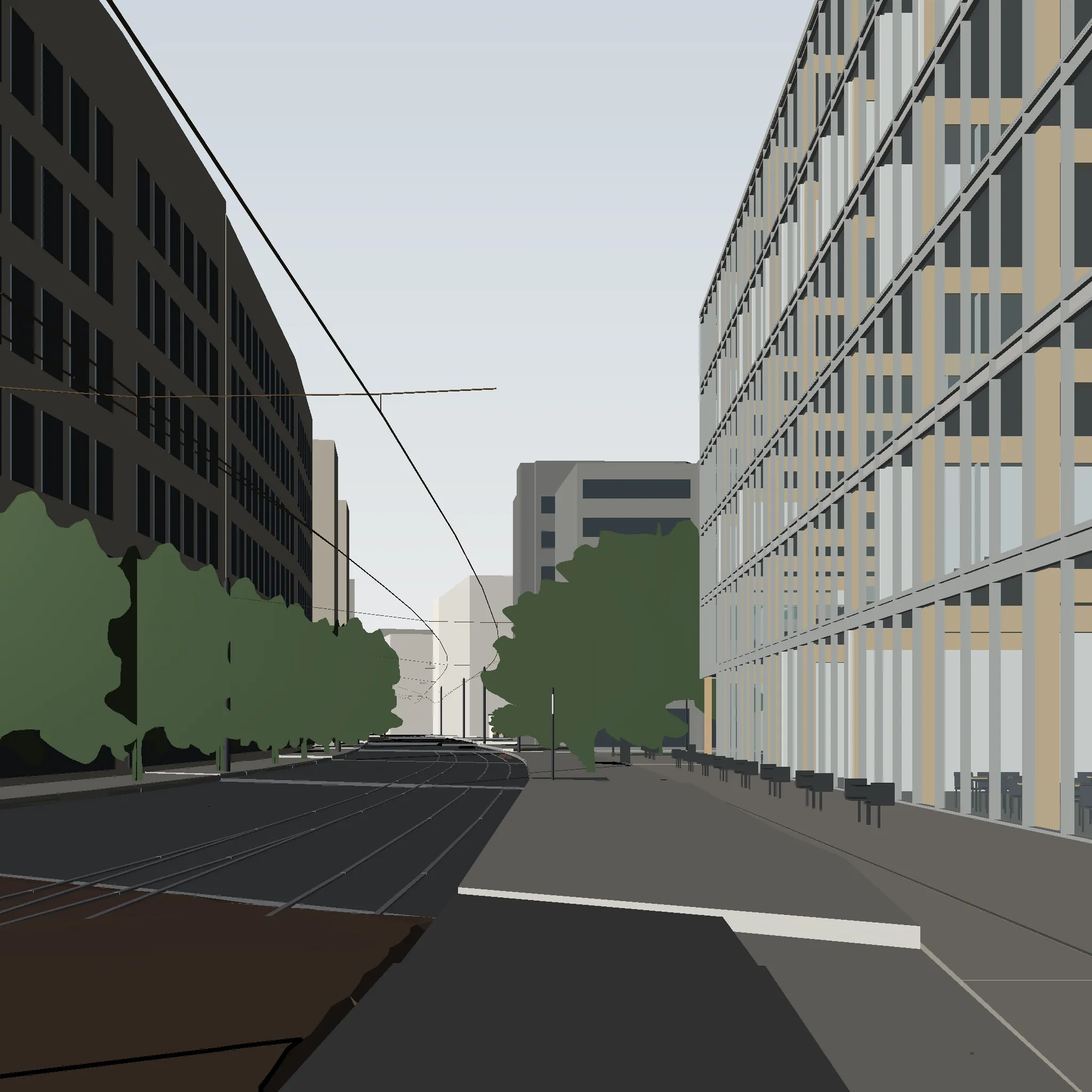
Zurich office · Along the tram line
AI-generatedRevit → GPT Image 2.6
Ask your AI assistant
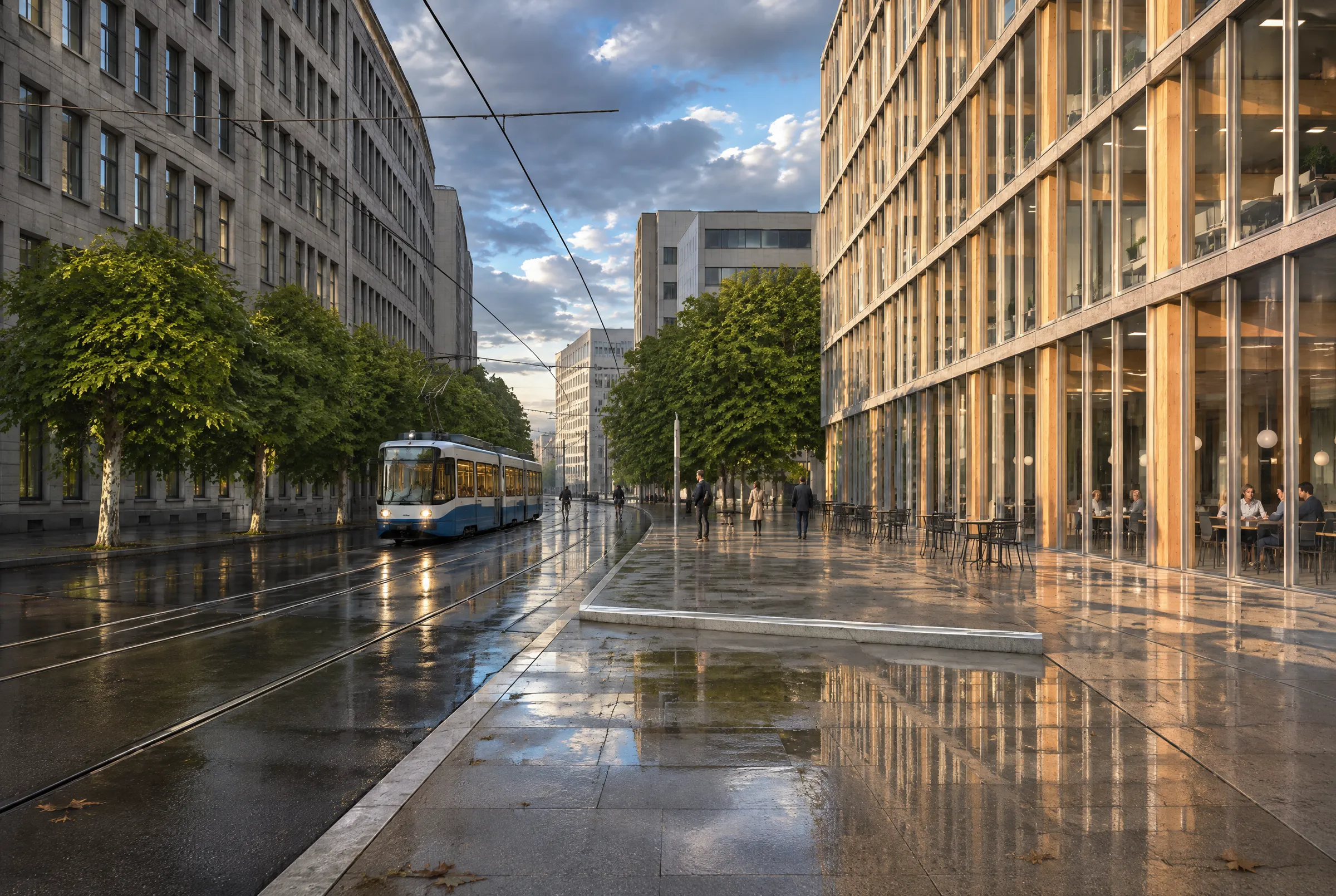
Take the Revit 3D view along the tram line and render it with GPT Image 2.6, in soft late-June evening sun.
Show the full prompt
Using the Archi Automate MCP, take the Revit 3D view [the street along the tram line, looking towards the façade] as the reference image and render it with render_view on [GPT Image 2.6 Sunburst], with this image prompt: Camera: keep the input camera exactly. A square 1:1 frame, a level camera with no tilt, every vertical strictly vertical. Eye height 1.8 m on a tram-stop platform, the horizon at one third of the frame height from the bottom, a classic centred one-point view along a Zurich street with a tram line toward the vanishing point. Do not raise, move, tilt or widen the camera. Treat the input image as the exact geometry and camera. Keep every building element exactly where it is: outline, proportions, the number, spacing and thickness of the mullions, timber posts, glulam beams and slab-edge bands, floor and roof edges, openings, the tram rails, the overhead contact wires, the span wires and masts, the platform and its kerb, the stop sign post, and the cafe tables on the forecourt. Keep the horizon height and the frame exactly as in the input. Do not add, remove, move, bend or resize any part of the building. Change only how materials, light, sky, vegetation, people and atmosphere look. Architectural visualisation in calm, matte daylight with two clear zones of light. A bright, hazy sky in soft warm white-grey with gentle, barely visible cloud mottling; no blue sky, no sunset colour, and no sun disc anywhere in the frame. The sun is in the west, behind the camera on the left, 25 degrees above the horizon, and rakes along the office facade on the right at a grazing angle. The tall city buildings across the street on the left, about 26 m high, hold the whole street in their shadow: the street, the rails, the platform, the forecourt with its cafe tables, the street trees and the glazed ground floor of the office lie in a calm, cool, deep shade, clearly darker than the rest of the image but full of detail, never black. Above that shadow the office stands in warm, soft evening sunlight from the first floor up to its roof edge: five storeys in sun. The shadow edge runs level along the whole facade on the slab band just above the glazed ground floor, about 5 m above the street, slightly soft from the haze. In the sun the light grey slab bands and the silver mullions turn a warm cream and the honey timber behind the glass glows softly; in the shade they stay cool grey and muted. The sunlight is a pale warm cream, never orange or golden. The city buildings on the left face away from the sun: their facades are entirely in shade, a cool, muted grey-beige, clearly darker than the sunlit upper office facade. The asphalt, the rails, the platform and the forecourt are a dark, cool grey, the darkest part of the image. In the shade the glazed ground floor of the office reads darker too: the glass reflects the shaded street and the interior behind it is dim. The contrast between the shaded street with the ground floor and the sunlit storeys of the office above it is the subject of the image. The dark street and trees form the bottom third of the frame, and the eye rises from them to the lit facade. A muted, warm-neutral palette with low saturation; highlights creamy, never clipped. Light aerial haze softens the trees and the distance. Surfaces read matte and quiet with a fine, even grain; vegetation is soft and slightly impressionistic. Calm, legible and hand-finished, like a quiet image printed on matte paper. Building: on the right, the long street facade of a six-storey timber-frame office: a flush glass curtain wall with slim natural silver anodised aluminium mullions and a light grey slab-edge band at every floor, light honey-coloured glulam timber posts and beams just behind the glass, office desks visible inside. The ground floor is flush glass with cafe tables on a stone forecourt in front of it (there is no arcade), and a covered corner recess at the far end. This street facade has no awnings and no sun shading: do not add any. Site: a Zurich street with a tram line: two rail pairs in the asphalt on the left, overhead contact wires on masts with span wires, a tram-stop platform with a granite kerb in the foreground, a row of street trees on each side receding to the vanishing point, and on the left the plain facades of older city buildings. Season and time: late June, just after half past six in the evening. The input is a plain Revit model view, and some of it is placeholder. Render each as what it stands for, never as it looks: - The flat green cut-out shapes with thin dark trunks are placeholders for real mature deciduous trees: render real trees with natural trunks, branches and layered leafy crowns in the same positions, each no larger than its cut-out, in deep green shade. The near-side trees screen the pavement at the vanishing point; keep them there. - The dark brown patch of ground at the bottom left is wrong: it is asphalt, render the whole street as grey asphalt with the rails set into it. - The plain white and grey blocks of the neighbouring buildings are simplified massing: render them as real Zurich plaster and stone buildings with regular windows, in exactly the same outlines. - The small dark frames along the forecourt are placeholders for cafe tables and chairs: render light bistro furniture in the same places. - There is no shelter on the platform: keep the platform open, with only the stop sign post. People: the image model adds the street life, because none of it is modelled. One Zurich city tram in the blue-and-white city livery, with no logos, no text and no route numbers, stands at the stop on the left-hand tracks about 20 to 35 m ahead, in the left half of the frame, in the street's shade, never covering the office facade. About twelve small figures in everyday clothes, all 10 m or more from the camera: people waiting on the open platform ahead and boarding the tram, people at the cafe tables and walking on the forecourt, and two cyclists on the street further down. At true scale, calm, never crowding the facade, none posing, none looking at the camera. Avoid: saturated blue sky, sunset colour, orange or pink light, a sun disc, lens flare, dramatic clouds, HDR look, glossy CGI reflections, pure black or crushed shadows, flat even light over the whole scene, sunlight on the street, the pavement or the ground floor, sunlit facades on the left side of the street, a pale or light street surface, vignetting, tilted or converging verticals, visible brush strokes, oil-paint or canvas-weave texture, people posing or looking at the camera, people close to the camera, text, logos, signage or watermarks, cars, a second tram, a tram shelter or any shelter on the platform, an arcade on the ground floor, awnings or blinds on this facade, invented landmarks or towers.
A tram street between older buildings and the Zurich office, a sample Revit model, its upper floors in evening sun, the street in shade. AI-generated: rendered by OpenAI GPT Image 2.6 Sunburst; the tram, cyclists, people and the windows and stone of the neighbouring blocks are the render's.
- Engine
- OpenAI GPT Image 2.6 Sunburst
- Input
- Revit
- Time
- 52 s
- Cost
- $0.216 (metered estimate)
- Date
- 2026-11-14
- Tools
- Revit → render_view
- MCP calls
- render_view
Method notes
AI-generated image · OpenAI GPT Image 2.6 Sunburst. Not a photograph. Not a built project. This is a render of the Zurich office, a sample model made in Revit through the Archi Automate MCP. It is not a building that was built, and Archi did not design a real building here.
Soft Tone. Calm, matte daylight that lets the architecture speak: a square frame, a low horizon, everyday life going on. The calm expression treats the building like a well-made print. A square frame, looking straight at the main façade, a horizon low in the image and verticals kept vertical. Soft daylight under a pale, hazy sky, muted colours and a fine matte grain. The foreground often sits in shade while the building catches the light, so the architecture reads clearly and positively.
How it was made. OpenAI GPT Image 2.6 Sunburst rendered this image through Archi Automate’s render_view, from a Revit 3D view of the sample model. The view was exported from Revit and sent as it was. It is a restyled view, composition guided by the model view, not a record of the model.
Added by the render, not in the model view: the sky, the leaves of the street trees, the tram, the cyclists and the people, and the windows and stone of the neighbouring buildings, which the model has as plain blocks. The tram, the cyclists and the people are generated by the image model and are not real.
The image on this page is re-encoded for the web. Compare it with its Revit view before relying on a detail.